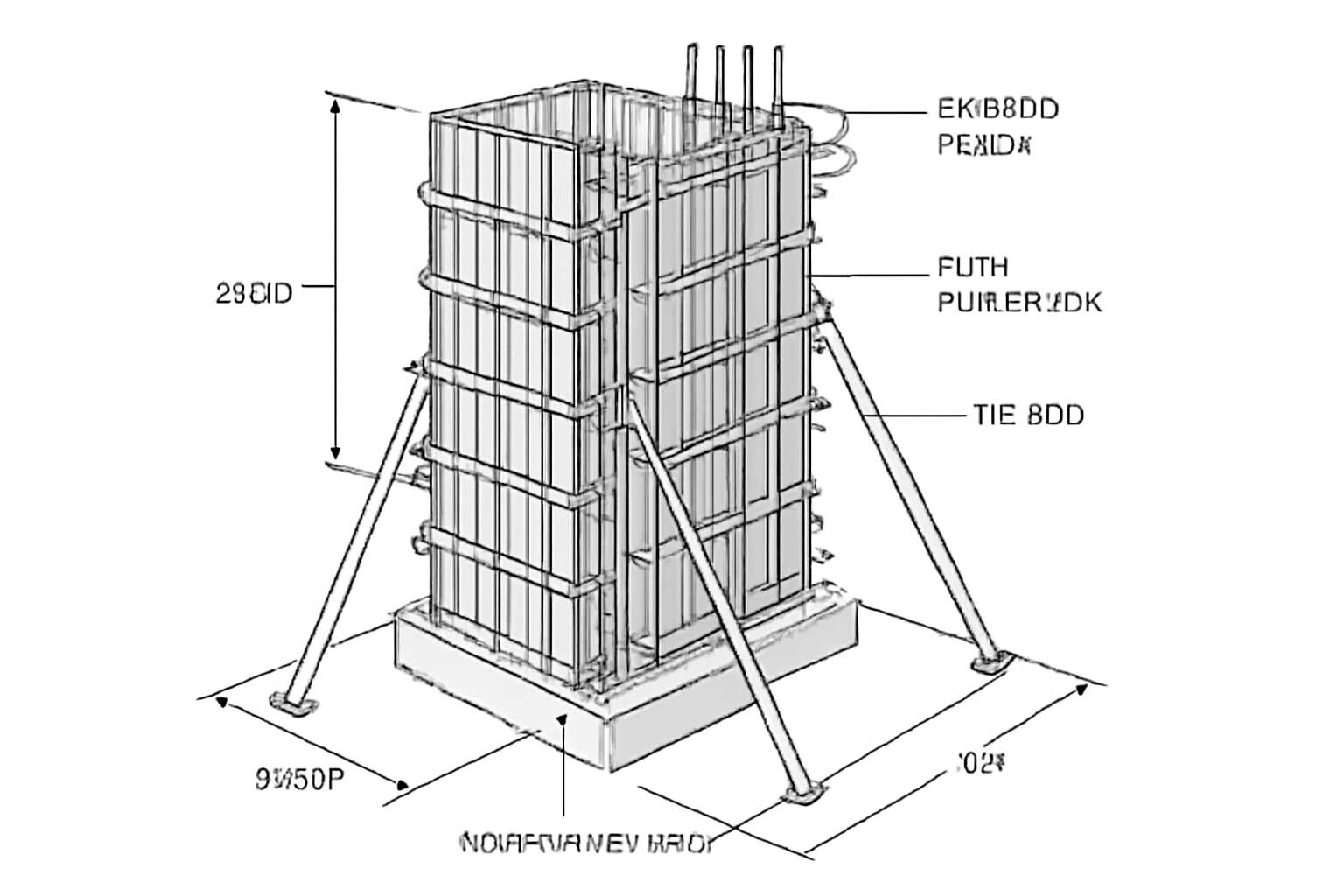
Fundamentals of Formwork Drawings
Definition and purpose of formwork drawings
On South African sites, a shaky formwork diagram can turn a smooth pour into a stuttering challenge. A well-drawn outline reduces surprises, guiding crews from footing to scaffold with quiet certainty. Clarity here translates into safety, speed, and cost discipline—three rare currencies on any project.
Fundamentals of formwork drawings translate geometry, material behavior, and sequencing into a practical plan. Drawings communicate where panels sit, how shores brace the shape, and where pours begin and end. It aligns formworkers, engineers, and supervisors toward one working rhythm. When teams harmonize around what the drawings show, pours flow more predictably, timelines tighten, and a spark of craft returns to the site.
Key elements to read at a glance include:
- Scale, dimensions, and orientation
- Panel layout, joints, and bracing
- Pour sequence and safety clearances
Key symbols, lines, and notation
On bustling South African sites, a single symbol can steer a pour from precision to hesitation. The formwork diagram communicates not just geometry but intent, translating complex realities into a shared rhythm for crews. Clarity here fosters safety, speed, and cost discipline—every mark matters!
Key symbols, lines, and notation are the metronome of the draft: they whisper where panels sit, where shores brace the shape, and how pours begin and end. When the marks read cleanly, teams move with quiet certainty.
Key symbols to read at a glance include:
- Panel outlines and hatch patterns indicating concrete faces
- Solid versus dashed lines for visible edges and hidden details
- Pour boundary arrows and extension lines for sequencing
- Centerlines, axis marks, and reference symbols for alignment
Scales, dimensions, and orientation anchor the diagram to reality, while notation clarifies bracing, shores, and pour limits—the quiet grammar of safe, predictable construction in the formwork diagram language.
Common scales, units, and tolerances
On South Africa’s bustling sites, a single scale choice can tilt a pour from precision to delay. In the formwork diagram, scales, units, and tolerances act as a quiet compass, translating heavy realities into workable instructions for crews and inspectors alike!
- 1:50 for general layouts and panel planning
- 1:100 for site-level coordination and layout checks
- 1:20 for detailing interfaces, edges, and embeds
Metric units keep the numbers intimate and universal—millimetres and metres lace through every dimension, while tolerances express how far a line can drift without compromising safety. Linear tolerances usually sit within a few millimetres per metre, with angular tolerances kept to fractions of a degree, ensuring joints sit true and straight across the structure.
Role in construction sequencing and planning
On South Africa’s bustling sites, timing is money and precision is safety. A formwork diagram acts as a shared language, shaping expectations and reducing miscommunication across crews, inspectors, and supervisors. It translates complex geometry into clear, actionable instructions that keep pours moving on a feasible rhythm.
Fundamentals of formwork drawings in construction sequencing and planning rest on three core actions:
- Define the pour sequence and access routes
- Pinpoint edges, joints, and embeds for accurate alignment
- Coordinate crane windows, set removal, and inspection timing
When teams study the diagram together, the risk of rework drops and the project moves with a shared tempo. In South Africa’s evolving urban landscape, this alignment supports safety, efficiency, and accountability on every pour, from foundations to final slabs.
Regulatory and safety considerations
On South Africa’s busy sites, a single misread line in a formwork diagram can derail a pour and echo through the schedule. Safety and compliance aren’t roadblocks—they’re rails. Regulatory and safety considerations translate building codes into practical, worker-friendly guidance that keeps everyone on track. I’ve seen well-drawn forms save more than concrete; they save time and reputations.
From a fundamentals angle, the diagram must embody regulatory expectations without bogging teams down in jargon. It should clearly show safe access, embed locations, and removal windows, ensuring inspections happen on time. From a SA perspective, this means aligning with OHSA and local building standards. From a human standpoint, it’s about calm on site, fewer debates, and safer pours.
- Compliance with OHSA and SANS 10400 building standards
- Hazard labeling, edge protection, and safe removal planning
- Coordination with crane operations and inspection windows
Interpreting Rebar and Concrete Details in Formwork Plans
Reading reinforcement placements and clearances
On South Africa’s crowded building sites, a misread rebar plan can halt progress. A surprising 62% of formwork delays trace to misinterpreting rebar and concrete details in the plan. I’ve learned that interpreting these details demands more than arithmetic; it requires tracing each bar’s intent through the formwork diagram and understanding how it sits inside the poured mass. The aim is harmony between reinforcement and substrate, with a whisper of tension between ambition and accuracy!
Reading reinforcement placements and clearances is like reading a code that governs the structure’s heartbeat. Look for how bars align with edges, joints, and pour heights, and how the concrete cover is specified. Consider these cues:
- Bar spacing and concrete cover
- Development lengths and bar staggering
- Clearances to formwork faces and edges
- Embedded sleeves, hooks, and anchor points
When these elements line up, the formwork diagram reveals the true choreography of steel and concrete, turning a complex plan into legible instruction.
Deciphering chamfers, laps, and spacers
A sobering field stat keeps echoing across South Africa’s crowded sites: 62% of formwork delays stem from misreading rebar and concrete details. Interpreting these cues demands more than arithmetic—it’s tracing intent through the formwork diagram, watching how each bar sits inside the poured mass and how its shadow lines up with edges, joints, and pour heights. I sense the drama in the quiet grammar of steel and concrete—ambition tempered by meticulous accuracy.
I read lines like a compass for a structure’s heartbeat. Deciphering chamfers, laps, and spacers sharpens that perception. Here are cues that anchor interpretation:
- Chamfers mark edge transitions and form-stiffness
- Laps indicate splice lengths and structural continuity
- Spacers keep bars from drifting and maintain required clearances
When these cues converge, the choreography reveals its true pattern—steel within concrete, a rhythm that guides the pour and the cure.
Understanding load paths and form pressures
On crowded South African sites, a sharp eye for load paths can save a whole project. The formwork diagram traces how forces travel from slab to column, and how form pressures from fresh concrete push against panels and ties. Reading these cues reveals whether bracing and panel layout will hold under pour and cure. It’s a quiet map that keeps ambition in check and accuracy in sight.
Interpreting these details can be distilled into a few focal points:
- Load paths through frame connections
- Pressure behavior during pour and curing
- Interactions between supports and formwork panes
The diagram becomes live in the field, guiding the eye across edges and joints as concrete settles. It anchors decisions, the way steel and concrete align in a single rhythm, and it keeps the project moving with clarity—formwork diagram as a steady heartbeat of the build.
Extracting critical dimensions from drawings
A seasoned foreman once whispered, ‘Measure twice, pour once.’ It’s a creed that rings on crowded South African sites, where the formwork diagram serves as a quiet compass, guiding nails and panels as concrete settles into shape.
Its lens on rebar and concrete details lets us interpret placement and cover with calm authority. From the drawings, we extract critical dimensions, observe embedment depth, and sense how staggered bars will sit against the panels once the pour begins.
Observe these cues within the diagram:
- Rebar geometry and alignment
- Concrete cover and chair position
- Joint clearances around penetrations
In that rhythm, the rebar details breathe with the project, and the diagram keeps the plan visible as the cure settles.
Coordination with structural and MEP drawings
“Measure twice, pour once,” a creed that still rings on crowded South African sites, where the formwork diagram acts as a quiet conductor guiding nails, panels, and patient hands as concrete learns its frame.
Interpreting rebar and concrete details requires a careful ear for both structural and MEP drawings. Rebar geometry and alignment govern how the cage sits against the form, while embedment depth, chair positions, and concrete cover determine restraint under pressure.
Coordination across disciplines keeps the pour on track—the diagram becomes a single page of truth where services, sleeves, and penetrations find their places without clash. When the cure begins, the rebar and concrete details breathe with the project, visible and vigilant.
Types of Formwork Drawings and Their Applications
Cast-in-place formwork layouts for slabs and walls
In the hush before a pour, the formwork diagram unfolds like a map of shadows, guiding crews through gravity. I watch the linework breathe as the crew moves; a single drawing cradles a skeleton, turning voids into certainty and doubt into alignment.
Types of formwork drawings vary by task: shuttering plans for slabs and walls, with layouts that choreograph supports, alignments, and pour sequences. They translate complex geometry into readable guidance, marrying load paths with the quiet poetry of construction. We read it at dawn, letting the lines settle.
Applications reflect the formwork diagram’s versatility:
- Cast-in-place slabs: floor decks with edge forms and openings
- Cast-in-place walls: vertical forms embracing openings and recesses
- Stair and core forms: tapering supports for vertical travel and utilities
This is the charge of the formwork diagram, a nocturne guiding concrete from form to final silhouette, where structure and shadow meet in South Africa’s built environment!
Precast formwork diagrams and assembly drawings
Precast formwork diagrams and assembly drawings choreograph the factory-to-site journey. A formwork diagram becomes the blueprint for module production, transport, and erection, translating complex geometry into a readable, fixable plan. Different drawings serve distinct purposes: isometric assembly visuals, shop-fabrication diagrams, and lifecycle notes—each clarifying tolerances, joint details, and lift points. While on the ground, these diagrams quiet the chaos of precast deployment.
- Precast panel diagrams that define soffits, ribs, and openings
- Assembly drawings for joints, connections, and grouting paths as part of the formwork diagram
- Shop-fabrication diagrams detailing module production tolerances
- Isometric and layout diagrams guiding erection sequencing on site
In South Africa’s evolving built environment, precision travels from factory to site—panels, stairs, cores—ensuring consistent quality as precast modules meet their places. It is the quiet discipline that keeps erection aligned with design intent.
Temporary works and erection sequencing diagrams
On South Africa construction sites, a precise rhythm emerges when a formwork diagram steers the day—from design intent to the last bolt tucked away. The right diagram quietly trims waste and rework; a veteran once said, “The diagram is the project’s conscience.” This is where temporary works and erection sequencing begin to breathe.
Temporary works diagrams map all supports, shoring, and crane clearances before concrete meets form. These drawings, at their core, are a formwork diagram in action, translating engineering logic into actionable steps on site. Erection sequencing diagrams plot the order of module lifts, alignments, and anchor points so panels arrive in concert with safety and design intent.
In practice, teams rely on these diagrams to coordinate factory-to-site workflows, minimize clashes, and keep quality consistent across precast pours. Key elements often highlighted include:
- temporary works diagrams
- erection sequencing diagrams
- lift plans and path clearances
Curved geometry and complex formwork detailing
Across South Africa’s bustling sites, a telling stat keeps echoing: up to 30% of formwork rework stems from misread curves and misaligned tolerances. The formwork diagram, when crafted with care, becomes the project’s compass—translating engineering intent into a practical language the team can follow. It quietly aligns design with field reality, trimming waste and safeguarding timelines.
- Curved geometry and freeform shell detailing
- Modular shuttering for rapid assembly in tight spaces
- Chamfers, reveals, and spacers in challenging geometries
Types of Formwork Drawings and Their Applications—curved geometry and complex formwork detailing demand specialist diagrams. Whether it’s freeform shells, arches, or intricate precast modules, these drawings anchor on-site accuracy and safety.
Together, they translate geometry into a shared language on site, turning plans into a tangible rhythm that speaks to form, function, and safety long before the first pour.
Standards, Tools, and Best Practices for Formwork Documentation
Industry standards and codes to follow
Across South Africa’s construction sites, misdrawn lines on a formwork diagram can stall projects and inflate costs; studies show up to 15% of on-site rework traces back to documentation gaps. Industry standards insist the diagram aligns with SANS frameworks and international codes, with revisions stamped and circulated to all stakeholders. When accuracy is non-negotiable, the path from design to pour becomes predictable and safer.
Tools empower this discipline!
Modern kit turns precision into practice:
- Centralized digital library of standard symbols and families
- Version control with change history and traceable approvals
- Automated cross-checks against structural and MEP drawings
This toolkit keeps the formwork diagram coherent as projects move from drawing board to daylight.
In the South African context, annotations reflect field realities while upholding standards, ensuring a reliable record of load paths and safety considerations in the formwork diagram.
Software and CAD tools for formwork drawings
Standards for formwork documentation software and CAD tools anchor every drawing in accuracy and safety. South Africa’s sites demand alignment with SANS and international codes, with revisions stamped and circulated. A robust formwork diagram becomes a living record, reflecting field realities while preserving clear lines of accountability.
Tools empower this discipline. Modern toolkit turns precision into practice:
- Centralized digital library of standard symbols and families
- Version control with change history and traceable approvals
- Automated cross-checks against structural and MEP drawings
Best practices in formwork documentation hinge on clarity and continuity. In the South African context, annotations reflect field realities while upholding standards, ensuring a reliable record of load paths and safety considerations in the formwork diagram. Regular audits and clear sign-offs nurture collaboration, linking design intent to on-site execution and daylighting the project’s future.
Quality assurance, reviews, and approvals
On South African sites, a formwork diagram is more than lines on a page; it is a covenant between design intent and field reality. Rigorous quality assurance, aligned with SANS and international codes, stamps revisions and circulates them with traceable authority. This living document records load paths and safety considerations while preserving clear accountability from desk to deck.
- Audit trails and change history
- Clear sign-offs from designers, engineers, and site supervisors
- Version-controlled repository with access controls
- Automated cross-checks against structural and MEP drawings
Across every inspection, the formwork diagram earns trust through traceability, clarity, and disciplined sign-offs, linking design intent to on-site execution.
Version control, updates, and change management
Standards, tools, and best practices for formwork documentation form the quiet backbone of every safe, efficient build. A well-managed formwork diagram sits on the desk like a trusted ledger—aligned with SANS and international codes, ready for revision as field realities shift. In South Africa, version control, updates, and change management keep load paths honest and safety margins intact, turning a plan into dependable on-site action.
Key tools and processes include:
- Cloud-based document repositories with role-based access
- Automated cross-checks against drawings and MEP models
- Structured change requests with sign-offs and audit trails
These standards ensure the diagram remains trustworthy, traceable, and adaptable on site, linking design intent to reality with quiet resilience.
Common drafting mistakes and how to prevent them
In South Africa’s crowded build sites, the formwork diagram isn’t just a drawing—it’s the quiet referee that keeps pours on schedule and under control. A single misread dimension can ripple into rework, safety risk, and delays, so standards anchor every drafting decision and turn complexity into manageable clarity.
Tools and best practices keep that anchor solid: cloud-based document repositories with role-based access guard against accidental edits; automated cross-checks against drawings and MEP models catch clashes before steel is cut; structured change requests with sign-offs and audit trails ensure every revision is traceable and approved.
- Inconsistent dimension references across sheets
- Ambiguous symbols or nonstandard legends
- Unclear revision marks or missing sign-offs
Together these standards, tools, and habits help the formwork diagram remain trustworthy on site, translating design intent into dependable, compliant actions across South Africa’s varied projects.


0 Comments